JSON blocks
Blocks compose reusable document structure from JSON. Code plugins provide calculations, external I/O and programmable behavior. Both formats support the contract below; format is inherited from the containing document. DOCX definitions expand into flowing content and may carry section state; PPTX definitions expand into positioned slide content and may carry slide effects.
Complete custom example
This document requires no plugin or catalog lookup. Change the definition to change every invocation.
{
  "name": "docx",
  "props": {
    "theme": "consulting",
    "blocks": {
      "summary": {
        "description": "A short conclusion with an optional source group.",
        "slots": {
          "title": { "type": "string", "default": "Summary", "maxWords": 8 },
          "text": {
            "type": "string",
            "required": true,
            "minLength": 1,
            "maxWords": 60
          },
          "source": { "type": "string", "maxWords": 20 }
        },
        "body": [
          {
            "name": "heading",
            "props": { "level": 2, "text": { "$slot": "/title" } }
          },
          { "name": "paragraph", "props": { "text": { "$slot": "/text" } } },
          {
            "$if": "/source",
            "then": [
              { "name": "divider", "props": { "thickness": 0.5 } },
              {
                "name": "paragraph",
                "props": {
                  "text": { "$slot": "/source" },
                  "font": { "size": 9 }
                }
              }
            ]
          }
        ]
      }
    }
  },
  "children": [
    {
      "name": "section",
      "children": [
        {
          "name": "block",
          "props": {
            "ref": "summary",
            "slots": { "text": "Retention improved after the service change." }
          }
        }
      ]
    }
  ]
}
Definitions and slots
props.blocks maps names (^[a-zA-Z][a-zA-Z0-9_-]*$) to { description?, slots, body, section?, slide? }. Definitions belong to one document and inherit its format; no format property is accepted. The selected renderer determines available components and operations. A name conflicting with a registered plugin is rejected. Standard primitives have a separate namespace; block.props.ref always names an inline definition.
slots maps names to descriptors. Supported type values: string, number, integer, boolean, object, array, component. Descriptors support description, required, default, enum; strings support minLength, maxLength, maxWords, oneLine; numbers support minimum/maximum; arrays support items, minItems/maxItems; objects support named properties with the same descriptors. Unknown invocation slots and unknown declared-object properties are errors.
A slot may also declare a role — actionTitle, takeaway, source, tracker or footer. A role says what the content is for so a quality profile can require it (a source under every chart) or measure it (an action title's line count); the theme only styles it, and no role adds a requirement on its own. The consulting-deck PPTX profile requires takeaway and source and bounds the actionTitle at two lines; the default profiles ask for nothing. Profile findings are warnings that advise by default and block only under a quality policy gate; a slot the definition itself marks required is a validation error regardless of profile.
Defaults apply only to missing values, including nested object properties. Empty strings, empty lists and false remain authored values; they do not select defaults. required rejects missing values; use minLength/minItems to reject empty content. Optional bindings omit undefined properties. $if treats missing, null, empty strings/lists and false as absent, after defaults resolve. Required-slot validation runs before omission, so optional groups cannot bypass requirements.
An invocation accepts only ref and slots, with no layout overrides. Component slots accept existing primitives or registered plugin components. They reject placement props x, y, w, h, position, grid, alignment, spacing and, on a group, gridConfig, direction, gap, weights; intrinsic image width/height remain valid. Placement and typography belong in the definition. Direct primitive authoring remains available outside semantic invocations.
Editor assistance
Block bodies, section headers/footers, and nested $if/$each compositions use schemas derived from the selected renderer and registered plugins, in both formats. The playground suggests component names, component props and binding directives, and accepts bindings in nested property values. Ordinary document props keep their literal-value schemas. Component names remain literal discriminators; use a component slot when supplying a whole component dynamically.
Invocations complete against the document being edited. The editor reads props.blocks from the text as it is (a half-typed definition is simply not offered yet) and installs a schema that names those definitions: ref completes the defined names with their descriptions, slots completes the selected block's slots with each slot's description, default and contract (required, word budget, one line, bounds, role), a component slot completes against the renderer's slide or section content, and mistakes are flagged inline with the verdict the runtime reaches — an unknown reference, a missing required slot, an undeclared slot, a value of the wrong type, a multi-line value in a one-line slot, or placement smuggled into a component slot.
Reference blocks — every definition of every document the server discovers, the shipped playground templates included — are offered too. At ref, a reference the document does not define yet inserts its definition (and the definitions it depends on) into props.blocks in the same edit, so no reference is left unresolved. Wherever a slide, a group or a section takes content — an empty object, a name being typed, an empty children array — every block is offered as a snippet: a complete invocation at typical slot cardinality (the source document's own invocation when it makes one), its text slots as tab stops, its definition brought along when missing. The same catalog is served at GET /api/discovery/blocks and written into the AI assistant's PPTX prompt.
Autocomplete follows the expected value type, including unions and referenced plugin schemas:
| Expected value | Additional directives |
|---|---|
| Number or integer | $count, $measure |
| String | $join |
| Array | $each, with its template typed as one array item |
| Object or boolean | References and $if only |
$slot, $item, $theme, $context and $if can supply any compatible value. Their default, then and else values retain the surrounding type. Starting a normal property hides whole-object directive alternatives; selecting a directive offers only its own options. A directive object cannot mix those options with ordinary component props.
Inside arrays, $if and $each may also insert a sequence of items. This is how a block body can repeat components; it does not make $each valid as the entire object-valued props. Evaluated values still pass runtime type, constraint and placement validation.
Bounded bindings
Bindings use JSON Pointers, including ~0/~1 escaping. Directive objects accept only the fields listed below; they never execute JavaScript or load code.
| Directive | Meaning |
|---|---|
{ "$slot": "/title", "default": "..." } | Slot value; optional fallback if missing. For a component slot, props: { ... } merges beneath the slot value's own props: placement and styling defaults live here, and the slot content overrides styling but never placement. |
{ "$theme": "/styles/label/size", "default": 10 } | Resolved theme token; missing token without fallback is an error. A list of pointers is tried in order, so a chrome recipe can override the type role it is drawn in: { "$theme": ["/chrome/sourceLine/color", "/styles/source/color"], "default": "textMuted" }. |
{ "$context": "/document/title" } | General engine context: document metadata, page width/height in twips, current section tracker in chrome, and /sources — every distinct source-role slot value in the document, in order. |
{ "$if": "/source", "then": [...], "else": [...] } | Select by presence; selected sequences splice into the surrounding sequence. else is optional. |
{ "$each": "/items", "template": { ... } } | Repeat one template value per item. $item binds the current item. Use a group for multiple flow children. A repeated element maps back to the item that produced it. |
{ "$item": "/label" } or { "$item": "" } | Current repeated item field, or the whole item; optional default. |
{ "$count": "/items" } | Array length, e.g. the number of equal-width columns. |
{ "$each": { "$item": "/cells" }, ... } | $if, $each and $count take an operand: a slot pointer, or one reference — { "$item": ... } for the current repeated item's own field or array, { "$slot": ... }, { "$context": ... }, { "$theme": ... }. A table repeats its columns, and each column its cells; a composition draws an optional recipe field only on a theme that states one. |
{ "$join": [...], "separator": " ", "keepEmpty": false } | Join scalar bindings; omitted values collapse unless keepEmpty is true. |
{ "$measure": "width", "fraction": 0.5, "unit": "twip" } | Current section body width/height; fraction 0–1, units pt (default), twip, in. |
DOCX repetition adapts content through ordinary flow/columns without shrinking typography. The complete playground template client-report-blocks.docx.json demonstrates two to four metrics using $count/$each, optional source text whose divider and spacing disappear together, and a table whose columns repeat over a slot and whose cells repeat over each column's own array. Bounds are explicit slot constraints and primitive dimension constraints. Unsupported count/text overflow is a hard error; automatic font shrinking and general expressions are not supported. Explicit blank paragraphs/spacers reserve space deliberately.
Section state
A DOCX definition may declare section: { tracker?, header?, footer?, pageBreak?, scope? }. Author invocations with section effects directly in a top-level section body. Nested composition may pass through transparent groups, but cannot install section state from columns, table cells or header/footer regions.
The engine resolves local trackers before chrome. scope: "following" carries the declared header/footer effect to later sections; default scope is local. Header/footer bindings see the receiving section’s page dimensions and /section/tracker, while retaining the declaring invocation’s slots. Last local tracker/chrome declaration wins. Explicit section header, footer and pageBreak take precedence. The declaring section defaults to a page break; a section that inherits chrome does not, so sections under one running head continue on the page unless the theme or the author breaks them (a header can only change at a page boundary, so chrome that varies per section needs pageBreak: true on each). Existing {PAGE} / {NUMPAGES} paragraph fields stay native Word fields.
The playground demonstrates cover, key-takeaways, section-opener, running-head, kpi-row, callout, data-table, chart-figure, figure, footnotes and the source-line the data and figure blocks invoke. These are names in that document, not registered engine components. General document operations remain engine code; visual compositions remain JSON.
A blueprint assembles these invocations into a whole-document plan: the client-report blueprint scaffolds a report from them, with every slot holding a marker and the client-report profile judging the result.
The report blocks
Every definition in client-report-blocks.docx.json binds its sizes and colours to the theme's type roles and chrome recipes with a safe default, so the same JSON renders on every bundled theme; the previews below are the house theme, rendered through LibreOffice. A report built from a cover, three section openers and one running head is generated on all four bundled themes in the test suite, warning-clean, and rendered through LibreOffice where one is installed: every page after the cover carries the document title and a live n / N, the sections flow onto one another, and the cover carries neither.
| Block | Slots | What the definition decides |
|---|---|---|
cover | title ≤ 12 words, subtitle ≤ 20, client ≤ 6, date ≤ 3, confidentiality ≤ 4, logo | A masthead: the theme's motif at the top edge (a stub of the measure, absent on a theme that declares none), the client in the eyebrow role beneath it, then the cover recipe's rule and the title a third of the way down the body, subtitle under it, and a Prepared for / Date / Classification band pinned to the foot of the text area under a hairline. A label whose value is missing is omitted with it. The band's position does not move with the title, so a one-line and a three-line title leave the page equally balanced |
key-takeaways | label, items 3–5 of ≤ 25 words | The key-takeaways recipe's rule, label role, hairline |
section-opener | number, title | Eyebrow number and a real level-1 heading, set as one unit: the gap that separates two sections is carried by the number and the heading under it carries none, so the number opens its section instead of trailing the one that ended |
running-head | title ≤ 6 words, confidentiality ≤ 4, date ≤ 3, pageNumbers | Header title and footer confidentiality · n / N · date, painted in the theme's tracker and footer type roles, inherited by later sections, which continue on the page |
kpi-row | items 2–4 of value ≤ 7 and unit ≤ 5 characters, label, delta, trend; source | Equal columns of statistic (a size smaller when there are four), the delta and its glyph beside the figure, a sourced hairline that collapses with the source |
callout | label (default "Note"), text ≤ 60 words | One hairline down the left in the theme rule colour, no fill; the label role over body text |
data-table | title, labelHeader, labels 1–24, columns 1–5 of header ≤ 14 characters, cells ≤ 10 characters 1–24, numeric (default true); notes, source | A label column at 22% of the measure, then data columns right-aligned header and cells; rows never split across pages and the header repeats; the row bound keeps the table on one page with its header; notes and source through the shared source-line block. Rounding stays the author's, and W_QUALITY_TABLE_MIXED_DECIMALS reports a slip at the column slot |
chart-figure | chart (component: highcharts, or chart on office-open), caption, takeaway, source (required) | The chart as given; **Figure {SEQ:figure}.** caption in the label role; the takeaway beneath in the quote role; the source through source-line. The block's takeaway and source slots are what W_QUALITY_CHART_ANNOTATION reads, so a chart placed here is annotated by them |
figure | image (component: image or visual), caption, source | The same numbered caption over the same figure sequence, so figures and charts number together; source through source-line |
footnotes | title (default "Notes and sources") | Nothing unless the document cites a source; otherwise a hairline, the title in the label role and a numbered list of every distinct source-role slot value in document order, from the engine's /sources context |
memo-header | label (default "Technical memo"), subject ≤ 16 words, to, from, date (required), cc | In place of a cover: the label in the eyebrow role, the subject at the heading-1 size, then **To**, **From**, **Date** and an optional **Cc** on one tab stop, closed by a rule. Defined in technical-report-blocks.docx.json; a running-head declared in the same section still numbers the pages |

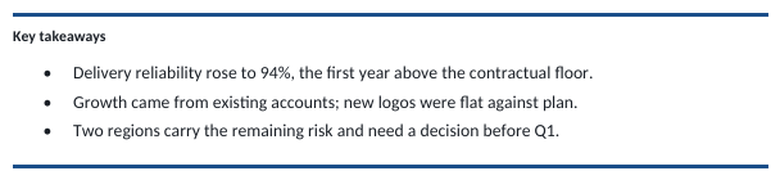
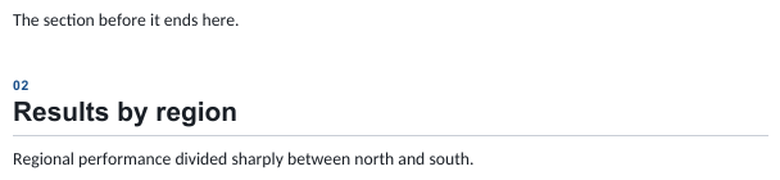
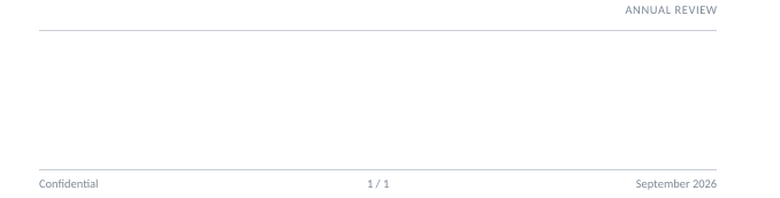


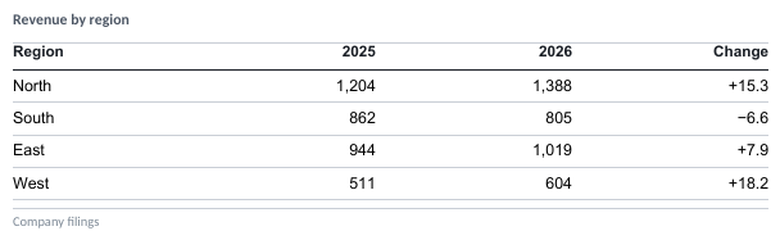
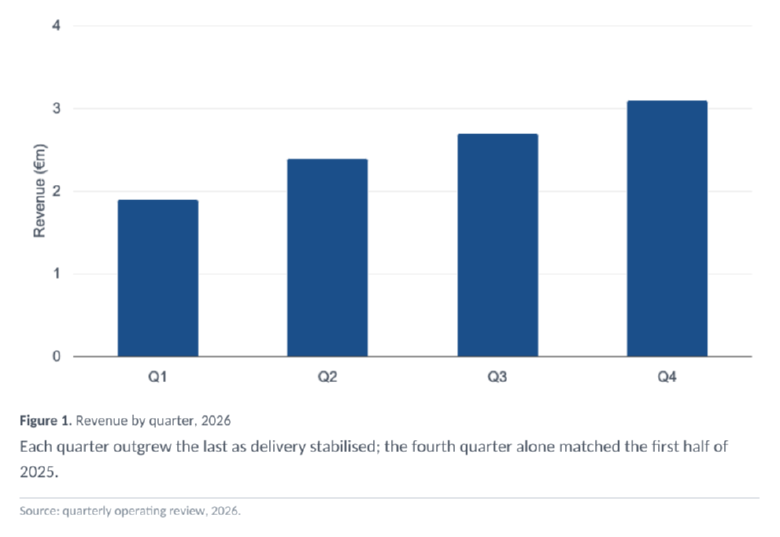
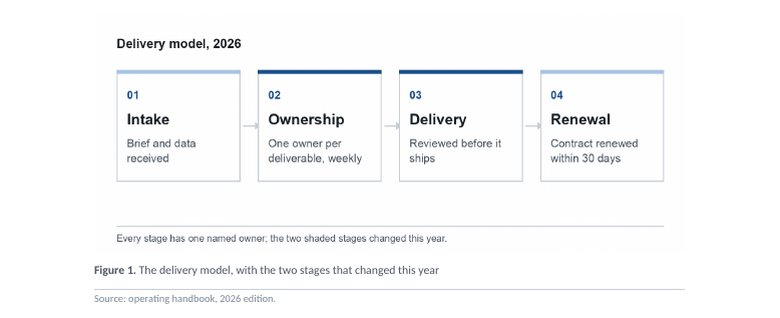


Two engine capabilities the figure blocks compose rather than implement. {SEQ:name} in any paragraph text is a Word SEQ field the compiler also counts, so Figure {SEQ:figure}. reads 1, 2, 3 in document order in Word, in headless LibreOffice and in the preview PDF alike (see shared text features). /sources in a DOCX block context is the list of every distinct source-role slot value across the document's invocations, in order; { "$each": { "$context": "/sources" } } walks it, and each item maps back to the slot it was written in.
Word draws figures with the face's own digits: Arial, the house heading face a statistic figure is set in, has lining tabular figures, so a KPI row's values align without a font feature. The document model does not yet expose OpenType number spacing; a theme that sets a proportional-figure face for stat would not get tabular figures from this block.
PPTX
A PPTX definition expands, at its invocation, into a transparent group of positioned slide content. A block is invoked as a slide child, beside coordinate-authored components; the definition owns every coordinate, and an invocation that states any is rejected. What the body can use beyond the content components:
| Operation | Where | Meaning |
|---|---|---|
| Frame | group with x/y/w/h or grid | A nested coordinate system: children position relative to the frame, and an omitted x/y or w/h means the frame's. See Slides & the grid. |
| Distribution | group with direction, gap, weights | Children take equal or weighted cells along the axis. An $each template inside a row redistributes for two, three or four items; an $if child that collapsed is not counted, so nothing reserves its space. |
| Nested grid | group.gridConfig, slide.grid | Grid placements inside the group resolve against this config, merged over the enclosing grid. A definition's slide.grid becomes the config of the group it expands into. |
| Component-slot props | { "$slot": "/chart", "props": { ... } } | The definition's frame and styling defaults for a component slot, merged beneath the slot content's own props. The content may not carry x, y, w, h, position or grid; intrinsic data such as chart data or image dimensions stays valid. |
| Bounded fit | text.fit: { maxLines?, shrink? } | Lines are estimated with the width model at the effective size; past maxLines, or the box height, the text steps down through the declared shrink sizes and takes the first that fits. Nothing else is tried: when no declared size fits, generation fails with text_fit_overflow at the authored slot. |
| Slide effects | slide: { background?, notes?, grid? } | Background and notes fill in what the invoking slide did not state; a slide that states its own keeps it; among several blocks on one slide the last declaration wins. Requires the block to be invoked directly on a slide, transparent groups excepted (invalid_placement otherwise). |
$theme | /styles/display/fontSize, /palette/rule, … | The resolved theme, type roles projected onto styles. Bind sizes with a default so a definition renders on a theme that declares no roles, and a list of pointers to let a chrome recipe override the role. |
$context | /document/title, /slide/width, /slide/index | Deck metadata (title, author, subject, company) and the invoking slide's canvas in inches and 1-based authored index. |
$measure | width / height, units pt (default), in | The slide canvas. |
section is DOCX-only and slide is PPTX-only; each is a block_format error in the other format. The rest of the contract — slots, defaults, $if, $each, $join, budgets, provenance, plugin composition, recursion limits — is the same in both formats.
The complete playground template consulting-deck-blocks.pptx.json carries the five consulting deck definitions, and every one of its slides invokes one. Each is a frame of the slide in percentages, binds every size to a type role with a safe default so it renders on every bundled theme and canvas, and draws the tracker top right and the page number bottom right where it has them; the consulting-deck profile is what asks for a takeaway or a source, never the definition.
| Block | Slots | What it draws |
|---|---|---|
cover | title ≤ 16 words, subtitle ≤ 20, client ≤ 8, date ≤ 6, confidentiality ≤ 6, logo (component) | An accent rule from the theme's cover recipe, client · date in the eyebrow role (the line needs the client), the title in the title role stepping down 32 → 28 → 24pt over three lines, the subtitle beneath, the logo top right at 18% of the width, confidentiality at the foot |
action-chart | title (action title) ≤ 24 words, tracker, chart (component), takeaway ≤ 40, source ≤ 24 | The action title with fit: { maxLines: 2, shrink: [24, 22] }, a chart at 68% of the width painted from the theme series, the takeaway beside it under an accent rule, the source beneath a hairline that collapses with it |
kpi-row | title, tracker, items 2–4 of value ≤ 7 and unit ≤ 5 characters, label ≤ 6 words, delta ≤ 12 characters; source | The action title over a row that distributes the items into equal cells (two take half each, four a quarter): value and unit in the stat role, the unit in the muted colour, the delta in the label role beneath, the label under that; the source at the foot |
two-column | title, tracker, text ≤ 50 words or bullets ≤ 5 of ≤ 10 words, content (chart, highcharts, table or image), source | The action title over a 1.1 : 1 row: prose, or the bullets as one bulleted paragraph list, on the left; the content in the definition's frame on the right, painted by the theme; the source at the foot |
statement | assertion (action title) ≤ 14 words, support ≤ 30, tracker | A short accent rule, the assertion in the display role stepping down 28 → 24 → 22pt over three lines, the support in the quote role beneath: a divider or a closing slide |
Copy a definition from jto://blocks (or from the deck) into props.blocks, then invoke it; action-chart for instance:
{
  "name": "block",
  "props": {
    "ref": "action-chart",
    "slots": {
      "title": "Revenue grew 18% as on-time delivery reached 94% of contracted work",
      "tracker": "Performance",
      "chart": {
        "name": "chart",
        "props": {
          "type": "bar",
          "valAxisTitle": "Revenue (€m)",
          "data": [
            {
              "name": "Revenue",
              "labels": ["Q1", "Q2", "Q3", "Q4"],
              "values": [4.2, 4.6, 5.1, 5.6]
            }
          ]
        }
      },
      "takeaway": "Reliability, not price, drove the gain.",
      "source": "Source: quarterly operating review, 2026."
    }
  }
}
Both renderer profiles draw the expanded primitives: pptxgenjs and office-open see the same groups flattened into slide elements, and a backend that lacks a capability the expanded content needs (a bubble chart on office-open) says so with the same unsupported_renderer_feature diagnostic it gives coordinate-authored content — never by waiving the block.
Breaking changes
Slide templates are gone: the root templates array, the slide template and placeholders props, the layout prop, the MISSING_TEMPLATE, UNKNOWN_PLACEHOLDER and PLACEHOLDER_NO_POSITION warnings, and the masters/placeholders renderer capabilities. A template becomes a definition with slide.background and its objects as body; a slide that used it invokes the block as its first child; a placeholder becomes a slot, its defaults the props merged beneath the slot. No aliases or migration layer exist. The three shipped playground decks are converted; the corpus template cases are replaced by block cases with new goldens.
Composition, validation and inspection
Bodies can invoke other document-local blocks or explicitly registered code plugins. Plugins can emit blocks or primitives. Missing registrations produce validation errors; references do not install dependencies. Emitted components pass through standard DOCX validation. Expansion is deterministic for JSON-only blocks, with a 64-level / 50,000-node evaluator limit and a 64-level / 100,000-node combined plugin traversal limit. Cycles stop at these limits with block_expansion_limit.
Definition errors point into /props/blocks/<name>. Content errors and generated-node quality findings map to authored invocations/slots, including nested and repeated expansion. jto_validate with includeCompiled: true returns the primitive tree and source map. The plugin generator’s expandStandardDefinition() exposes its source map too.
jto://blocks provides definitions, derived slot schemas, budgets and source-template pointers for agentic authoring, in both formats. Copy selected definitions and any transitive block dependencies into props.blocks. The catalog does not register runtime names. Use jto_workspace_inspect with paths: ["/props/blocks"] to read actual definitions at a workspace revision; includeBlocks: true adds definition-derived slot schemas and invocation fill pointers; no catalog entry is inserted into the document implicitly.